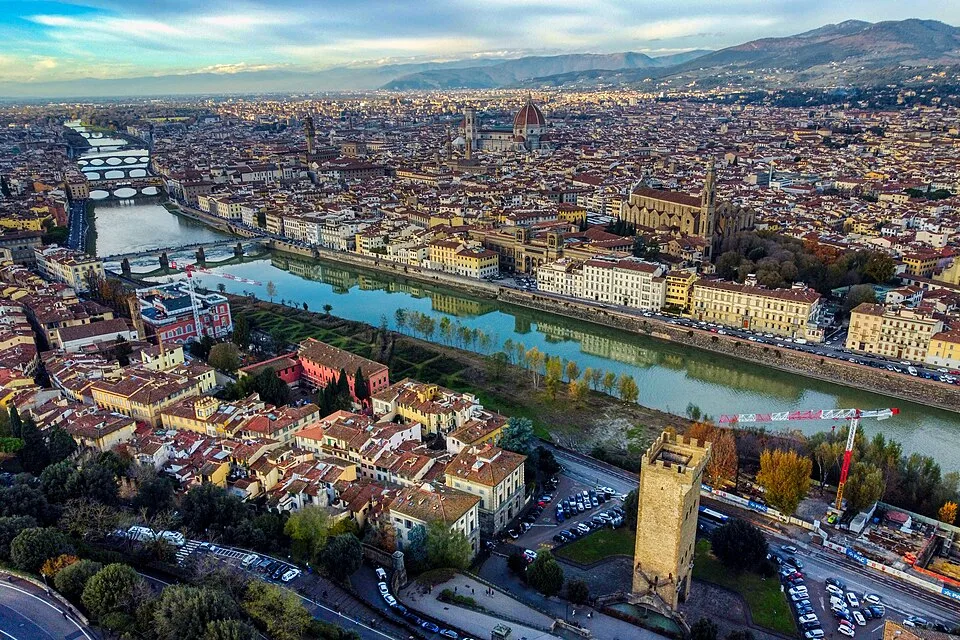
Best Instagram spots in Florence — Piazzale Michelangelo, the Bardini Garden and the complete photo guide
Florence's most photographed view is from Piazzale Michelangelo — but the tour bus crowds arrive by 9am and by 10am the terrace is dense with 500 people photographing the same composition. The Bardini Garden below Piazzale Michelangelo gives the same Duomo panorama from a lower, more intimate angle with wisteria foreground in April and almost no visitors in any season. Here is the complete Florence photography guide.
Piazzale MichelangeloBest before 7am (sunrise) — empty terrace, perfect Duomo alignment
Bardini Garden€10 — same Duomo view from below, wisteria in April, almost empty
Ponte Vecchio from Ponte Santa TrinitaEvening — best light hits the Ponte Vecchio from the west at sunset
San Miniato al MonteAbove Piazzale Michelangelo — 360° view including the tower, zero crowds
Oltrarno courtyard viewsVia dei Bardi 36 — the specific framed Duomo view through a gateway
Brunelleschi's Dome from belowPiazza di San Giovanni — the specific foreshortened angle from street level
What are the best Instagram spots in Florence — where, when, and what makes each location extraordinary?
Piazzale Michelangelo — the essential Florence view done correctly: The Piazzale Michelangelo (the 19th-century panoramic terrace above the Oltrarno, at 104m — built 1869 by Giuseppe Poggi as part of the Florence urban expansion under King Vittorio Emanuele II) gives the standard Florence panorama: the Duomo, Giotto's Campanile, the tower of the Palazzo Vecchio, and the Arno with its bridges. The view is genuinely extraordinary. The problem: tour buses deliver groups from 9am onward; by 11am the terrace has 500-1,000 people. The solution: arrive by 7am (sunrise in summer — the Duomo dome receives the first direct light from the east, turning coral-orange in the first 20 minutes of sunrise; the empty terrace gives a clean composition). The night view (11pm-1am — the Duomo and Palazzo Vecchio are illuminated from below) is the second-best timing. Access: walk up from Piazza Poggi (30 minutes, steep but signed), or Bus 13 from the center (10 minutes). The Bardini Garden (Giardino Bardini — the specific Florence photography secret): The Bardini Garden (Via dei Bardi 1 — or entrance from Boboli Gardens with combined ticket; €10 single entry) is the Florence garden that the local photography community knows and the tourist circuit ignores. The specific reason: the upper terrace of the Bardini gives the Duomo-and-Arno view at a slightly lower angle than Piazzale Michelangelo and with a specific foreground — in April (late April, specific to the wisteria flowering timing), the wisteria tunnel leading up to the terrace is in full bloom, creating a purple-white flower frame with the Duomo visible at the end of the vista. The view from the terrace is photographically different from the Piazzale Michelangelo version — the Campanile and Duomo are closer in relative size, the Arno is lower in the composition, and the hillside vegetation provides immediate foreground. The garden has approximately 10-30 visitors at any time versus 500-1,000 at Piazzale Michelangelo. Ponte Santa Trinita (the correct bridge for Ponte Vecchio photography): The Ponte Santa Trinita (rebuilt 1567 by Bartolommeo Ammannati after the 1557 Arno flood, destroyed by German mines in 1944, rebuilt from recovered stone in 1957-1958) gives the most photographically interesting view of the Ponte Vecchio — looking east along the Arno, the Ponte Vecchio's specific profile (the overhanging shops on both sides, the Corridor of Vasari above) appears in the middle distance. Best time: 30-60 minutes before sunset (June: 8-8:30pm; December: 3:30-4pm) when the western light rakes along the Arno and hits the Ponte Vecchio facade with horizontal golden light. San Miniato al Monte (the hill above Piazzale Michelangelo — the view that includes Piazzale Michelangelo itself): The church of San Miniato al Monte (Via delle Porte Sante 34 — free, open daily 9am-7pm) sits on the hill above Piazzale Michelangelo. From the church facade terrace, the view includes the Piazzale Michelangelo terrace in the foreground (with the copied David visible as a small figure), the Arno valley, the Duomo, and the entire Florence urban panorama — the only location where the Piazzale Michelangelo itself is part of the composition rather than the viewpoint. The church's Romanesque-Gothic facade (11th-12th century, the finest early medieval facade in Florence, with specific green-and-white marble geometric decoration) provides the most photogenic architectural foreground of any Florence viewpoint.
📜 Brunelleschi's Dome — what made it technically impossible and how Brunelleschi built it anyway
The dome of Florence Cathedral (the Cupola di Santa Maria del Fiore — completed 1436, still the largest masonry dome in the world at 45.5m diameter) was technically impossible to build using any existing 15th-century construction technique at the time Filippo Brunelleschi (1377-1446) proposed it. The specific problem: a stone or brick dome of 45.5m internal diameter requires a temporary wooden framework (the centring) to support the masonry while it is being built — the centring for a dome of this size would require more timber than was available in the entire Florentine republic, and would be structurally inadequate under the weight of the masonry in any case. Brunelleschi's solution: build the dome without centring. The specific technical innovations: (1) the herringbone brick pattern (the opus spicatum arrangement — laying bricks at 90° to each other in alternating vertical courses) creates a self-supporting interlocked structure during construction; (2) the double-shell design (an inner shell and an outer shell connected by ribs and rings, with a hollow space between — reducing weight while maintaining structural integrity); (3) the eight primary ribs and the horizontal stone chains embedded in the masonry (functioning as compression rings, counteracting the outward thrust of the dome that had collapsed 14th-century attempts). The construction lasted from 1420 to 1436 — 16 years of Brunelleschi's 69-year life. The specific quality of the Dome viewed from below (the Piazza di San Giovanni, looking up at the octagonal drum and the dome above it): the foreshortened perspective from street level directly below the lantern gives the single most geometrically extraordinary view in Florence — a compression of the 45.5m diameter into a near-vertical composition that requires a 20-second vertical tilt of the neck.
More Florence and Tuscany photo guides
What are Italy's most surprising historical facts that completely change how you see the country?
Fifteen Italian historical facts that most travel guides omit but that transform the experience of visiting: (1) Rome was not built in a day — but it was built mostly in two: The two most intense Roman construction periods (the Augustus period 27 BC-14 AD, when Augustus famously "found Rome brick and left it marble," and the Hadrian period 117-138 AD, when the Pantheon, Hadrian's Villa, and the Castel Sant'Angelo were built) account for the majority of surviving Roman architecture. The intervening 150 years between them produced relatively little of the surviving record. (2) The Colosseum was not called the Colosseum in Roman times: The Colosseum (the Flavian Amphitheater — built 70-80 AD under Vespasian and Titus) was called the Amphitheatrum Flavium (Flavian Amphitheater) throughout the Roman period. The name "Colosseum" comes from the Colossus of Nero — a 30m bronze statue of the Emperor Nero that stood adjacent to the amphitheater (the statue was melted down, but the name transferred to the building). The Venerable Bede (8th-century English monk) was the first writer to use "Colosseum" for the building. (3) Venice was founded by refugees from the Roman Empire's collapse: The Venetian origin tradition holds that Venice was founded by mainland Italians fleeing the Attila invasion of 452 AD — the specific group was the population of Aquileia (the Roman city destroyed by Attila in 452 AD, the largest city in northwestern Italy at the time) who fled to the lagoon islands. The city-state that grew from this specific refugee community became the longest-lasting republic in European history (697-1797 AD — 1,100 years of continuous republican government). (4) The Vatican City is the smallest sovereign state in the world at 0.44 km²: The Lateran Treaty of February 11, 1929 (between Mussolini's Italy and Pope Pius XI) created the Vatican City as a sovereign state — specifically to resolve the "Roman Question" (the dispute between the Italian state and the Catholic Church that had existed since the Italian army seized Rome from the Pope in 1870). The treaty also established the Concordat (the legal relationship between Italy and the Church that still governs the relationship in modified form today). (5) The specific moment when the Roman Republic became an Empire: Historians disagree about the exact moment — but the most defensible answer is not the assassination of Julius Caesar (44 BC) and not the formal declaration of Augustus's powers by the Senate (27 BC) but the Battle of Actium (September 2, 31 BC) when Octavian (later Augustus) defeated Mark Antony and Cleopatra, ending the period of competing power centers and establishing a single military-political supremacy. (6) Florence in the 15th century had a population of approximately 60,000 people — smaller than a contemporary small English market town: The Florentine Renaissance (the most consequential cultural production period in European history) was produced by a city-state smaller than contemporary Harlow or Slough. The specific implication: the cultural achievement density was extraordinary — the same generation that included Brunelleschi, Ghiberti, Masaccio, Donatello, and Fra Angelico all lived within walking distance of each other in a city smaller than 2km across. (7) The Italian unification (Risorgimento) was opposed by the majority of its own population: The unification of Italy (1859-1871) was a project of the Piedmontese crown, the liberal middle class, and the specific revolutionary movement around Garibaldi — but large portions of the Italian population (the southern peasantry, the Catholic population, and the Austrian-administered northern populations) were either indifferent or actively hostile to unification. The specific Mezzogiorno resistance: the "brigantaggio" (brigandage) in the south (1861-1871) was a sustained armed resistance to Piedmontese rule that claimed more Italian military lives than the Risorgimento wars themselves. (8) Mussolini built the EUR district in Rome: The EUR (Esposizione Universale Roma — the planned 1942 World's Fair site, never held due to WWII) was designed by Marcello Piacentini under Mussolini's commission (1936-1942) and is the most complete surviving example of Italian Fascist urban design — the Square Colosseum (the Palazzo della Civiltà Italiana, 1938-1943) is the specific building that has become an international design icon. EUR is still a functioning Rome neighborhood — the Palazzo della Civiltà is Fendi's global headquarters. (9) The specific reason Italy has 20 regions: The Italian regional system (20 regions, established by the 1948 Constitution) was designed as a compromise between the unified centralized state (the Piedmontese model inherited from unification) and the federalist tradition (the pre-unification city-state and ducal state tradition). The five special-statute regions (Sicily, Sardinia, Val d'Aosta, Trentino-Alto Adige, Friuli-Venezia Giulia) were given special autonomy for specific political reasons: Sicily and Sardinia to prevent separatist movements immediately post-WWII; Val d'Aosta and Trentino-Alto Adige to accommodate French and German-speaking minorities respectively; Friuli for its specific border sensitivity with Yugoslavia. (10) The Mafia did not emerge from poverty: The specific academic consensus on Mafia origins (Diego Gambetta's "The Sicilian Mafia: The Business of Private Protection," 1993) is that the Cosa Nostra emerged not from poverty but from the specific property rights vacuum of post-Bourbon Sicily (1860-1880) — when the Bourbon feudal system collapsed (the lands redistributed after Italian unification) but no functioning property rights enforcement system replaced it. The Mafia developed as a private protection and contract enforcement service for landowners and merchants who needed reliable guarantee systems that the new Italian state couldn't provide in Sicily's specific power vacuum.
What are Italy's finest viewpoints that require neither a ticket nor a hike and that most visitors never find?
Ten Italian viewpoints accessible without a ticket, without a long walk, and without joining a queue — all genuinely extraordinary: (1) The Janiculum Hill (Gianicolo) in Rome: 85m above the Tiber, 20 minutes walk from Trastevere, free, open 24 hours. The 180-degree Rome panorama takes in the Pantheon dome (barely visible among the rooflines — the only view of the Pantheon dome from above at street level, since it is lower than most people realize), the Vittoriano monument, the Colosseum in the far southeast, the St. Peter's dome, and the Castelli Romani hills beyond. The specific cannon fire: at noon daily since 1904, the Gianicolo cannon fires a blank shot (the original timekeeping mechanism for Rome — before the city-wide clock synchronization system, the cannon told all Rome what time it was). (2) The Mura Aureliane walkable section in Rome: The Via Appia Antica Archaeological Park south of Rome gives 3-4km of walkable Roman road on the original 2nd-century Roman surface, with the original Appia tombs (the Via Appia was lined with tombs for the first 10km south of the city — Roman burial law required tombs outside the city walls) and the catacombs below. Free to walk the road surface; the catacomb visits require a ticket (€8). No tour buses. (3) The Ponte Sant'Angelo (Rome) at dawn: The bridge between the Castel Sant'Angelo and the historic center (the pedestrian bridge lined with Bernini's ten angel statues, 1669) is the finest example of Baroque public sculpture in Rome and gives the most photographically interesting view of the Castel Sant'Angelo from water level. Before 7am, the bridge has 5-10 people; at 11am it has 300. Free at all hours. (4) The Sacro Monte di Varese (Lombardy — the UNESCO pilgrimage hill above Varese): The Sacro Monte di Varese (one of the nine Piedmont and Lombardy Sacri Monti — UNESCO World Heritage 2003) is a pilgrimage walk of 14 stations (chapels with terracotta life-size figure groups illustrating the Mysteries of the Rosary) winding up through chestnut forest to the summit village of Santa Maria del Monte (880m). The final station gives a panorama of the Lombardy lakes and the Alps from Monte Rosa to the Ortler. Free to walk; the specific combination of religious art in natural settings with extraordinary landscape is available 365 days. (5) The Belvedere di San Luca above Bologna: The porticoed walkway (4km, 666 arches — the longest porticoed walkway in the world, UNESCO World Heritage 2021) from the city center to the Santuario della Madonna di San Luca on the Apennine hill above Bologna gives the city panorama from 300m. Free to walk; the sanctuary itself is free. The specific combination of Bologna below in the Po plain and the Apennine foothills extending behind gives the finest available view of the geographic position that makes Bologna Italy's central transport hub. (6) The Corso Italia walkway in Sorrento: The cliff top promenade above the Sorrento Marina Grande — free, 500m walk from the Sorrento Piazza Tasso — gives the specific view of the Bay of Naples from the western headland: Vesuvius to the northeast (visible across 30km of water), Capri to the south (3km), and the sweep of the Amalfi coast beginning to the east. Accessible by walking the Via Luigi di Maio from the Piazza Tasso downhill. At sunset in June: one of the finest views of Vesuvius available without climbing it. (7) The Taormina public gardens (Villa Comunale) view: The Taormina public gardens (Via Bagnoli Croce — free, open daily from 8am) give the specific Taormina panorama — the Teatro Greco on the hillside to the west, Etna behind it (visible on clear days), the Giardini Naxos bay below, and the Strait of Messina to the north. No ticket. No queue. The view from the garden terrace in the late afternoon (when Etna is silhouetted against the western sky) is the specific image that has defined Taormina for 200 years of travel literature. (8) The Piazzale della Vittoria in Genova: The hilltop piazza above the Genova Castelletto funicular (accessible by the Castelletto Levante ascensore — an old public elevator, €0.70 — from the Via Garibaldi) gives the Genova panorama: the Porto Antico, the Lanterna lighthouse, and the Ligurian Sea in a single composition. The specific surprise: Genova from above is a genuinely extraordinary city — the density of the historic palazzi di via Garibaldi (the UNESCO World Heritage street of 16th-century noble palaces) is visible as a roof-level pattern of terracotta and stone. (9) The Capitoline Hill (Campidoglio) in Rome at night: The Michelangelo-designed Piazza del Campidoglio (the Capitoline Hill square, reachable from the Via del Campidoglio staircase — free, open 24 hours) gives the specific night view: the illuminated Roman Forum below, the Colosseum in the middle distance, and the Palatine Hill on the right. The specific quality at 10pm: the Forum is lit by the conservation lighting installed in 2009 (warm LED illumination of the Temple of Saturn, the Arch of Septimius Severus, and the Via Sacra) that is more atmospherically correct than the previous floodlighting. Free, accessible on foot from any direction. (10) The Forte di San Martino above La Spezia (for the Cinque Terre panorama): The 19th-century fort on the hill above La Spezia (accessible by walking up via the Via San Bartolomeo — 30 minutes) gives the Gulf of La Spezia panorama with the Cinque Terre coast visible to the northwest. The fort itself is partially open on specific days (check with the La Spezia tourist office). The hilltop view, regardless of fort access, gives the specific geographic context of the Ligurian coast — the Apennines descending to the sea at the specific angle that created the Cinque Terre's difficult terrain and the terraced vineyard culture that produced Sciacchetrà wine.
Plan your Italian trip — free
Our AI builds a day-by-day itinerary with real transport, real opening times, real prices.
Build my itinerary →