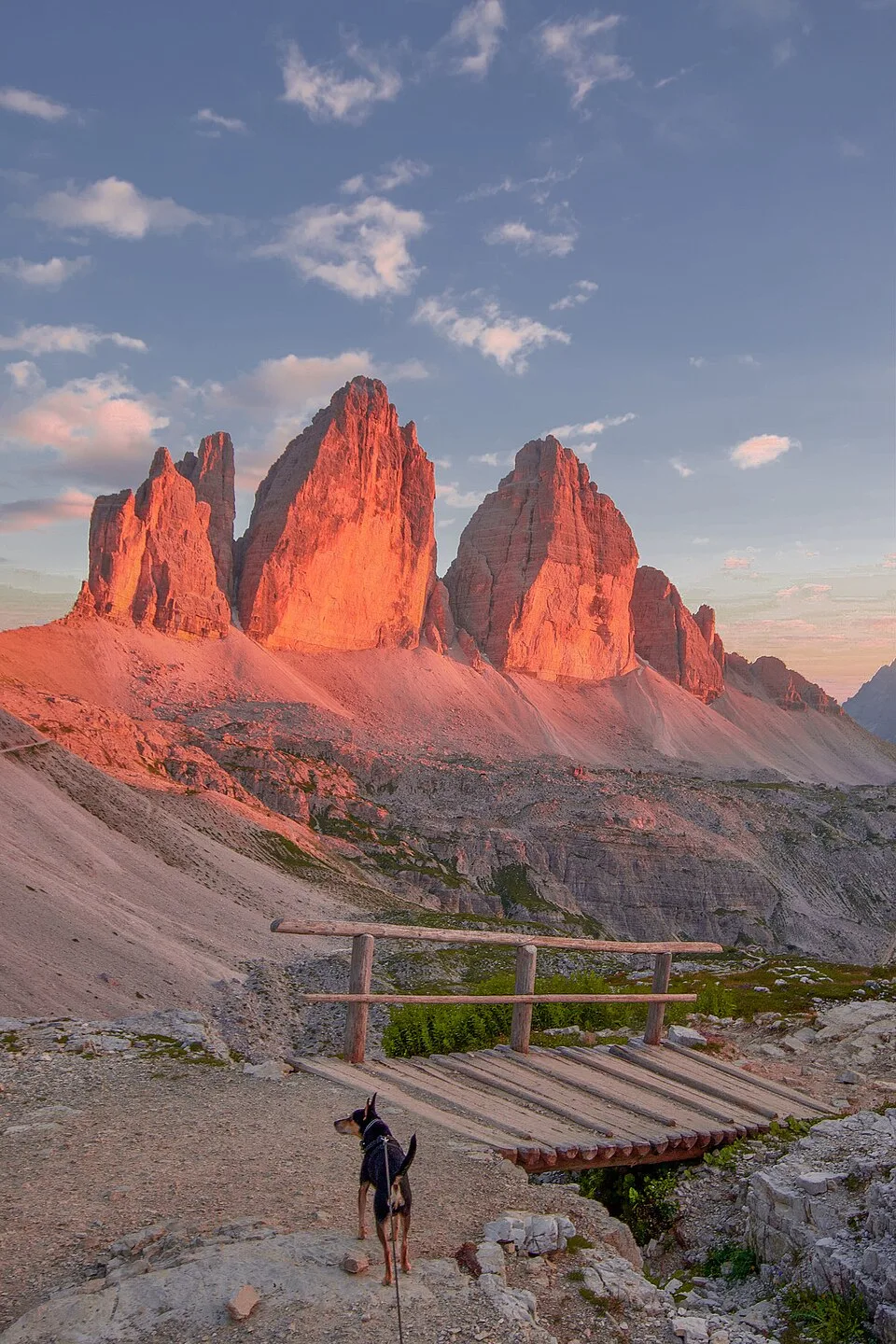
The via ferrata routes in the Dolomites aren't all the same, and they aren't all for everyone. There are routes a 10-year-old walks without fear and others that send experienced climbers home with shaking legs. The difference is in the grade, the exposure, and, above all, physical and psychological preparation. This guide separates the routes suitable for beginners from those for experts, with precise information instead of the enthusiastic vagueness you find elsewhere.
What a via ferrata is: history and origins in the Dolomites
The via ferrata routes (literally "iron ways") were born in the Dolomites during the First World War: the Italian and Austro-Hungarian armies installed ladders, steel cables, and iron rungs in the rock faces to move troops at high altitude. The Dolomites were a theater of high-altitude war, the White War between 1915 and 1917 saw fighting at 3,000 m. Some of today's via ferrata routes still follow the original military paths. After the war, mountaineers adopted them as sporting routes, and today the Dolomites have over 200 classified via ferrata routes, the highest concentration in Europe.
🎟️ Tours & tickets
🎟️
Via Ferrata Dolomites: tours & tickets
Compare guided tours, skip-the-line tickets and day trips for Via Ferrata Dolomites.
See availability & prices →We may earn a commission, at no extra cost to you.Via ferrata grades: what they really mean
| Grade | Difficulty | Who it suits |
|---|
| F (easy) | Simple equipped route, little exposure | Beginners, children 8+ |
| PD (slightly difficult) | Short vertical stretches, moderate exposure | Fit beginners |
| D (difficult) | Long verticals, significant exposure, upper-body work | Mountaineers with via ferrata experience |
| MD (very difficult) | Overhangs, extreme exposure, upper-body strength | Experienced climbers |
| ED (extremely difficult) | Only for athletes with specific training | Elite |
The 8 via ferrata routes in the Dolomites not to miss
1. Via Ferrata Lipella, Tofane (BL), Grade D
The Lipella is the most famous via ferrata in the Dolomites, climbed every year by thousands of mountaineers. It starts from the Rifugio Dibona (2,083 m) and rises along the Tofane walls to 2,840 m. Elevation gain: 760 m, duration: 5-7 hours round trip. The most exposed stretch is the vertical traverse halfway up, 20 m of nearly vertical wall with the Val di Fanes 500 m below. It's not for beginners. Access: from Cortina d'Ampezzo by bus or car.
2. Via Ferrata Brigata Tridentina, Lagazuoi (BL), Grade D/MD
Start from the summit of the Lagazuoi (2,835 m, reachable by cable car from Passo Falzarego) and descend along the walls that were a theater of war in 1915-17. The still-visible military tunnels are part of the route. A double experience: mountaineering and history. Duration: 4-5 hours. A guide is required for the less experienced.
3. Via Ferrata delle Trincee, Pasubio (VI), Grade PD
Not in the Dolomites proper but in the Vicenza Pre-Alps, the Pasubio is the site of the most intense fighting of the Italian Great War. The route follows the original front-line trenches. A lower grade than the Cortina Dolomites, suitable for those who want a first serious experience. From Valdagno (VI), 4-5 hours.
4. Via Ferrata Michielli-Strobel, Pelmo (BL), Grade MD
Monte Pelmo (3,168 m) is one of the symbols of the Belluno Dolomites. The route up to the Forcella Val d'Arcia is technical and physically demanding, grade VI stretches climbed with iron rungs. Only for trained mountaineers with experience on difficult routes. Access from San Vito di Cadore (BL).
5. Via Ferrata Bovero, Rocca Pietore (BL), Grade F/PD
One of the most beginner-friendly routes in the Dolomites: in a spectacular setting near the Marmolada, low grade, short route (2-3 hours), gear always in good condition. Ideal for those doing their first via ferrata or bringing children aged 10 and up. Access from Malga Ciapela (BL).
6. Via Ferrata Renato De Pol, Civetta (BL), Grade D
The Civetta (3,220 m) has the largest northwest wall in the Dolomites, 900 m of gray vertical rock. The De Pol route climbs the edge of this wall with dizzying views down to the valley floor. Not recommended when the sky is unstable, the Civetta creates its own local weather with clouds that form fast. From Alleghe (BL), 6-8 hours total.
7. Via Ferrata Punta Anna, Faloria (BL), Grade F
The easiest route in the Cortina d'Ampezzo area, suitable for families with children from age 8. It starts from the summit of Col dei Rossi (reachable by chairlift) and follows the ridge with views of Cortina and the Tofane. 2-3 hours, no significant vertical stretch, perfect for figuring out whether via ferrata is for you before committing to harder routes.
8. Via Ferrata Sentiero Attrezzato Sorapiss, BL, Grade PD
Lake Sorapiss (2,395 m), known for the turquoise-milky color of its glacial water, can also be reached via an equipped trail (not classified as a true via ferrata but with metal aids). 4-5 hours from Passo Tre Croci, spectacular and not excessively difficult for those with good legs and no fear of heights.
Mandatory gear for via ferrata routes in the Dolomites
- Via ferrata kit (lanyard + energy absorber): mandatory, not an option. Without an absorber, in a fall the jolt force on the carabiner is lethal. Via ferrata kits without an absorber (the old simple Y-lanyards) are obsolete and dangerous.
- Via ferrata harness: the combined model (waist + leg loops) is recommended for comfort when resting.
- Climbing helmet: mandatory, the Dolomite walls drop rocks regularly, especially after rain.
- Via ferrata gloves: the steel cables shred your hands after a few hours, specific gloves protect them and improve grip.
- Trekking shoes with a stiff Vibram sole: not city sneakers. The sole must be stiff to stand on the rungs.
- Layered clothing: at altitude the weather changes in 30 minutes, always keep a compact waterproof jacket in your pack.
Via ferrata gear rental: Cortina d'Ampezzo, Canazei (TN), Arabba (BL), and the main Dolomite centers have via ferrata rental shops. Average cost: a full kit (harness + helmet + lanyard) €15-25/day. It's worth renting for your first experience before buying your own gear.
When to do via ferrata routes in the Dolomites
The best period is July to mid-September. In June the high-altitude routes can have leftover snow and ice that make them dangerous without crampons. After September 20, afternoon thunderstorms become more frequent and the nighttime cold creates morning ice on the steel cables. Via ferrata routes and lightning are a lethal combination, the steel cables are excellent antennas. Set off no later than 7:00 in summer; be back at the hut or the car by 13:00-14:00.
Questions and answers on via ferrata routes in the Dolomites
Via ferrata Dolomites: do you need a mountain guide?
It isn't required by law, but for grades D, MD, and ED it's strongly recommended if you don't have specific experience. The Dolomite mountain guides (certified CAI Mountain Guides) cost €250-450 for a half day for 2 people, a real investment in safety. For grades F and PD, a hiker with a full kit and good fitness can go on their own. The Cortina Mountain Guides site (www.guidecortina.com) has the calendar of group outings at reduced prices (€50-90/person).
Via ferrata Dolomites: the best ones for kids?
The kid-friendly via ferrata routes in the Dolomites (ages 10 and up, good fitness, no severe fear of heights): Via Ferrata Punta Anna (Cortina, F), Sentiero Attrezzato Col Vidal (near Falcade BL, F/PD), Via Ferrata Bovero (Rocca Pietore, F/PD). For children under 10, even grade-F routes have psychologically difficult stretches, assess case by case and never without a guide.
How long does a via ferrata take in the Dolomites?
It depends on the grade and the length. Grade F/PD routes take 2-4 hours round trip. Grade D routes take 5-8 hours. Grade MD routes take 6-10 hours or more. The times on the CAI (Italian Alpine Club) signs are calculated for trained mountaineers, add 20-30% if you're not in top shape. In any case, always work out your maximum arrival time at the start (13:00-14:00 in summer) and count backward to set your starting time.
What the guides don't tell you about Dolomite via ferrata routes: the steel cables are usually cleaned and tensioned in May, before the summer opening. By the end of the season (September-October) some are slack or damaged by summer storms. Always check the state of the gear by touching the cables before clipping in, they should be taut, not loose and sagging. The mountain huts along the busier routes (e.g. Rifugio Dibona, Rifugio Lagazuoi) serve as safety points, the staff are trained in first aid and can call in the helicopter rescue (mountain emergency number: 118).
Physical preparation for Dolomite via ferrata routes
Physical preparation is the most underrated factor for beginners taking up Dolomite via ferrata. "Going to the gym" isn't enough, you need training specific to vertical activity. The exercises that help most: pull-ups (for the arm strength needed on overhanging stretches), squats and step-ups (for the quads needed on technical descents), core stability (to hold a vertical position on the wall). A month before a grade-D route, at least 3 weekly 45-minute sessions of these exercises significantly improve safety and enjoyment.
Psychological preparation matters just as much: many physically fit people can't finish a via ferrata because of vertigo or a fear of heights that surfaces in the moment. If you have doubts, start with an equipped trail (grade F) to gauge your reaction to exposure. It's not a failure, it's wisdom. Dolomite via ferrata routes are worth far more done calmly than abandoned halfway in a panic.
Via ferrata Dolomites: what happens if the weather changes during the climb?
Dolomite weather is unpredictable, summer afternoon thunderstorms can form in 30-40 minutes. Absolute rule: if you hear thunder, descend immediately. The steel cables of a via ferrata are excellent lightning conductors, being clipped to one during a storm is extremely dangerous. The nearest hut is always the gathering point in bad weather. Before setting off, check the mountain forecast (www.meteo.fvg.it or the MeteoTrentino app), the hourly forecasts by altitude are fairly accurate 6-12 hours out. Set off no later than 7:30-8:00 in summer to be at the summit or descending by 13:00.
Frequently asked questions from travelers on this topic
How to book this kind of experience in Italy without expensive middlemen?
Direct booking is almost always cheaper. For the main museums (Vatican, Colosseum, Uffizi, Borghese): the official sites have the same price or slightly lower than the third-party platforms, the only advantage of the third parties being the English-language interface. For guides: the provincial associations of licensed tour guides (every Italian provincial capital has one) offer certified guides at regulated prices, search "guide turistiche autorizzate [city name]". For transport: Trenitalia.com and Italotreno.it have the lowest prices; platforms like Trainline add a 10-15% fee.
Is Italy suitable for first-time solo travelers?
Yes, Italy is one of the easiest solo destinations in Europe. The public transport networks in the big cities work well (metro in Rome and Milan, vaporetti in Venice, trams in Florence). The historic centers are pedestrian. The language: Italian isn't English, but Italians in the tourism sector speak enough English. The essential apps for the solo traveler in Italy: Google Maps (offline too), Trenitalia, Google Translate with the camera for menus, and a hotel-booking app with free cancellation (Booking.com or Hotels.com).
What do Italians know about Italy that tourists don't?
Several fundamental things: the restaurants serving authentic food are recognizable by the presence of local customers at lunch (not by menus in 8 languages); the most beautiful churches are often not the famous ones but the hidden neighborhood ones; the local civic museums (not the national ones everyone passes through) often have extraordinary collections with no lines; Italian supermarkets (Esselunga, Conad, Carrefour) have excellent-quality products at normal prices, there's no need to buy oil and pasta in tourist shops at triple the price; Italian breakfast at the counter is always cheaper than the same item at a table (the coperto is real).
Before you go: the best resources for this kind of trip in Italy
The most reliable sites for planning: ENIT (the national tourism board, www.italia.it) for official information; the musei.it portal for up-to-date hours and tickets for state museums; Trenitalia.com for official rail timetables; the Civil Protection agency (www.protezionecivile.gov.it) for weather alerts. For independent planning: the Slow Food guides for local restaurants; the CAI (Italian Alpine Club) maps for trails; the provincial tourism-board sites for local events.
Plan your trip to Italy