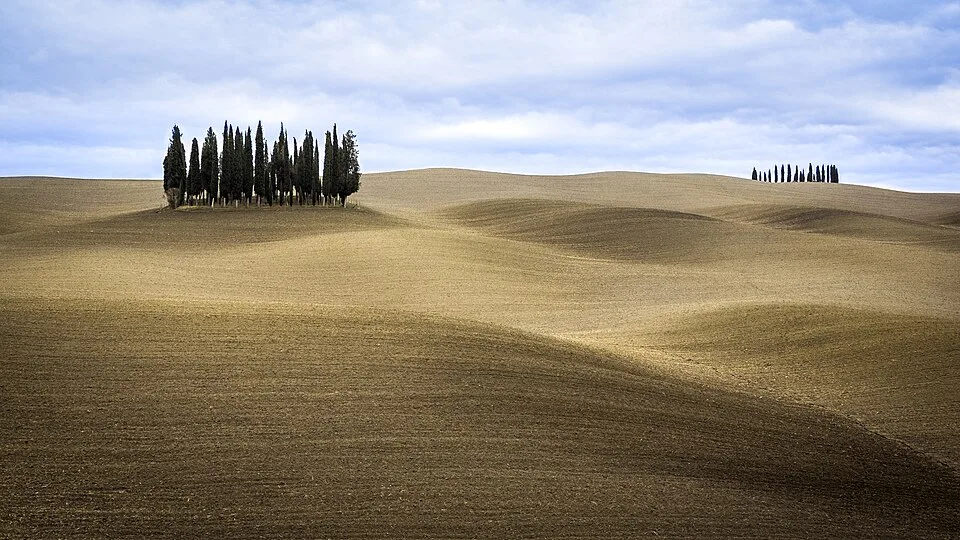
Cingoli sits at 631 metres above sea level on a ridge of the Apennine foothills in the Province of Macerata, in Italy's Marche region. The medieval walls encircle a hilltop so narrow and so elevated that the town looks down at every direction — to the east, the Adriatic is visible on clear days (55 kilometres away); to the west, the Apennine ridge rises behind the Esino valley; to the south and north, the rolling agricultural landscape of the Marche stretches in the particular combination of gentle hills and geometric field patterns that makes this region Italy's most undervisited quietly extraordinary territory. Cingoli has called itself the "balcone delle Marche" (balcony of the Marche) since at least the 19th century, and from its walls the designation is immediately self-evident. The town also has a Pinacoteca containing a documented Lorenzo Lotto altarpiece — a major Renaissance work by one of the Venetian Renaissance's most psychologically complex painters — in a museum that receives a fraction of the attention it deserves. This guide covers both.
The View: What You See From Cingoli's Walls
The panoramic views from Cingoli are the primary reason to visit and one of Italy's most consistently impressive regional panoramas. From the Belvedere Ugo Betti (the main panoramic terrace, immediately accessible from the town centre, named for the Cingoli-born playwright Ugo Betti) looking east: the entire Marche landscape spreads from the Apennine foothills to the coast — the Esino and Musone river valleys visible in their geographic relationship, the Adriatic coastline appearing as a silver-blue line on clear days, and on exceptional days (winter mornings after rain, when the atmosphere has the clarity of optical glass) the coast between Senigallia and Civitanova visible in detail. The photographer's light: morning eastward views in November–February with frost-clear air; sunset westward views in any season.
The scale of what the Cingoli view reveals about the Marche's geography is its specific educational value: from 631 metres you can see simultaneously the three characteristic zones of the region — the coastal strip, the middle hills (the colline of the Marche, where the most distinctive agricultural landscape is concentrated), and the first Apennine ridge. No amount of driving through the Marche communicates this geographic relationship as clearly as a morning at the Cingoli Belvedere.
The Lorenzo Lotto Altarpiece: A Major Renaissance Work in a Small Museum
The Pinacoteca Civica di Cingoli (Civic Picture Gallery), housed in the former church of Sant'Esuperanzio adjacent to the main cathedral, contains a signed and dated work by Lorenzo Lotto: the "Madonna del Rosario" (1539). Lotto (c.1480–1556) was one of the major Venetian Renaissance painters — a contemporary of Titian, a painter of extraordinary psychological depth and often unsettling emotional intensity, and a figure whose artistic reputation suffered for 300 years (he died poor, in a monastery at Loreto, having given his remaining property to the Loreto Sanctuary) before the 20th century's rediscovery placed him among the period's most significant artists.
The Cingoli "Madonna del Rosario" shows the Virgin surrounded by the mysteries of the rosary in the characteristic Lotto format — the composition is formally traditional (altarpiece with saints and donors) but the psychological intensity of the individual figures, the unusually direct gazes, and the brilliant colour palette (Lotto's greens and reds are among the most distinctive in the Venetian tradition) make it unmistakably his work. The painting was commissioned by Cingoli's Confraternity of the Rosary in 1539 and has remained in the town since. It is in excellent condition. The museum also contains works by Giovanni da Camerino and other Marche Renaissance painters, plus a modest archaeological collection from the Roman period.
Pinacoteca practical information: Piazza Vittorio Emanuele II, Cingoli. Hours: typically Tuesday–Sunday 10:00–13:00 and 15:00–18:00 (hours shift seasonally — verify at the Cingoli tourist office or comune di Cingoli website). Admission: €3–5. The Lorenzo Lotto altarpiece alone justifies the visit for any Renaissance art enthusiast. In the Marche region, Lotto's works are concentrated in Loreto (the Palazzo Apostolico) and in the Recanati Pinacoteca — Cingoli completes a Lotto circuit of the central Marche.
Roman Origins: Cingulum
The Roman town of Cingulum was founded by Titus Labienus — Julius Caesar's most trusted lieutenant, who later defected to Pompey's side at the outbreak of the Civil War (49 BC) and was killed at the Battle of Munda (45 BC). Labienus built Cingulum from his own resources as a personal colony, using the wealth accumulated during the Gallic Wars. Caesar's account of the Civil War (De Bello Civili) specifically mentions Cingulum as Labienus's town — the only Italian municipality in the Roman historical record explicitly attributed to a named individual's private foundation. The Roman street grid of Cingulum is partially visible in the current Cingoli urban layout; the forum likely occupied the area of the current Piazza Vittorio Emanuele II.
The medieval development: the Roman Cingulum contracted during the late imperial and early medieval period (as did most Roman Apennine towns with the disruption of the Roman road network that had sustained them). The current medieval urban structure — the tight perimeter walls following the hilltop's natural contours, the radial streets converging on the central piazza — was established between the 11th and 14th centuries. Cingoli was under the control of Macerata and later the Papal State through the medieval period, with the usual sequence of episcopal, communal, and signorial governance that characterises Marche hill towns.
Verdicchio Wine: The Liquid Identity of the Marche
Cingoli is within the Verdicchio dei Castelli di Jesi DOC zone — the wine appellation covering the Esino valley and the surrounding hills where the Verdicchio grape produces the Marche's most distinctive white wine. The Verdicchio grape (whose name derives from "verde" — green, referring to its greenish-yellow colour in the glass and the slight green tint of the grape itself) produces wines of high acidity, bitter almond finish, and mineral character derived from the Apennine limestone and clay soil. The Castelli di Jesi DOC (also the superior "Classico" and "Classico Superiore" versions from the historic core of the zone) is the most important; the Verdicchio di Matelica DOC (a different, more elevated and inland zone) is the less-known and often higher-quality alternative. Recommended producers accessible near Cingoli: Umani Ronchi (the zone's most internationally known producer, headquartered at Osimo), Garofoli (one of the oldest producers, 1871), and Monte Schiavo — all available at local enotece and cantinieri in Cingoli itself.
How to Get to Cingoli
Cingoli is deliberately not easy to reach without a car — which is partly why it remains as genuinely untouristed as it does. By car from Macerata (30km): 35 minutes via the SP77 (a winding but entirely manageable road). From Ancona (60km): 50 minutes via the A14 motorway to Civitanova Marche, then the SP77 inland. From Loreto/Recanati (45km): 55 minutes. By bus: CONTRAM regional buses connect Cingoli to Macerata and Jesi — service is limited (2–3 daily in some directions) and requires checking current schedules at the CONTRAM website. The car option is strongly recommended for practical visit comfort and for integrating Cingoli into a Marche road trip that includes Recanati (Leopardi's town, 40km southeast), Loreto (the Basilica della Santa Casa, 45km southeast), and the Frasassi Caves (50km north).
Where to Eat in Cingoli
Cingoli's small permanent population (approximately 10,000 in the municipality) supports a modest restaurant scene oriented toward local residents rather than tourists. The Marche cuisine at its best: vincisgrassi (the Marche baked pasta — a close relative of lasagna with a complex ragù that includes chicken giblets in the traditional version), olive ascolane (stuffed and fried olives — technically from Ascoli Piceno but ubiquitous throughout the Marche as an antipasto), and the local freshwater trout from the Esino and Musone rivers prepared grilled or in tegamino (in a small terracotta pan with oil and herbs). Paired with Verdicchio dei Castelli di Jesi Classico: one of the Marche's most coherent food-and-wine combinations.
12 Questions About Cingoli
Q1: Why is Cingoli called the balcony of the Marche?
The name refers to the panoramic view from Cingoli's hilltop at 631 metres: the entire Marche landscape from the Apennine foothills to the Adriatic coast is visible on clear days. The view encompasses approximately 1,800 square kilometres of landscape in a single panoramic sweep. No equivalent viewpoint in the Marche gives this complete east-west cross-section of the region's geography. The designation "balcony" is earned by the view's completeness rather than just its height — several other Marche hill towns are higher (Cingoli is not the tallest), but none provides the same unobstructed 360-degree panorama.
Q2: Who was Lorenzo Lotto and why is his painting in Cingoli significant?
Lorenzo Lotto (c.1480–1556) was a major Venetian Renaissance painter — a contemporary of Titian, celebrated in the 20th century after 300 years of neglect for his psychological intensity and unusual compositional choices. He spent significant time in the Marche region (in Recanati and Loreto) in the 1530s–1550s, leaving works that constitute the most important Lotto concentration outside Venice. The Cingoli "Madonna del Rosario" (1539) is signed and dated — unambiguously his work — and is in excellent condition. Finding a major signed Lotto in a small Marche hill town that almost no one visits is exactly the kind of Italian art discovery that rewards independent research over tourist circuit following.
Q3: Can I see the Adriatic from Cingoli?
Yes, on clear days. The distance from Cingoli to the nearest Adriatic coast is approximately 55 kilometres. On winter mornings after rain, when atmospheric clarity is maximum, the coastline is visible as a silver-blue line on the eastern horizon. Summer haze (particularly July–August) reduces visibility significantly. October and November consistently produce the clearest views. The best viewing point: the Belvedere Ugo Betti terrace, where a bench and orientation panel help identify specific landmarks in the landscape below.
Q4: Who was Titus Labienus and why did he build Cingoli?
Titus Labienus was Julius Caesar's most experienced legatus (senior officer) during the Gallic Wars (58–50 BC) — the military campaign in which Caesar conquered Gaul and accumulated the wealth and reputation that enabled the Civil War. Labienus built Cingulum (Cingoli) from his personal wealth earned during the Gallic campaigns. When the Civil War began in 49 BC, Labienus defected to Pompey's side — Caesar captured Cingulum shortly after and, notably, treated it with restraint rather than punishing the town for its founder's defection. Caesar's "De Bello Civili" describes the episode briefly. Labienus was eventually killed at the Battle of Munda in Spain in 45 BC — the last major battle of the Civil War.
Q5: Is Cingoli worth a full day or a half day?
A well-planned half-day (3–4 hours) covers the essentials: the panoramic view from the Belvedere, the Pinacoteca (Lorenzo Lotto), the medieval centre walk, and a lunch at a local trattoria. A full day allows: the same plus a walk on the paths below the walls (in spring, wildflower meadows extending down the hillside), exploration of the surrounding Verdicchio wine country, and a visit to the adjacent Riserva Naturale del Lago di Castreccioni (a reservoir lake 10km from Cingoli used for sailing and swimming). Cingoli works best as part of a Marche multi-day itinerary that includes Recanati (Leopardi's birthplace, 40km) and Loreto (15km from Recanati).
Q6: What other Marche towns should I combine with Cingoli?
Recanati (40km southeast): birthplace of Giacomo Leopardi — Italy's greatest 19th-century poet — with the Leopardi family home, the Pinacoteca Civica with Lotto works (the "Transfiguration" — a different Lotto from the Cingoli painting), and the Casa Leopardi museum. Loreto (45km southeast): the Basilica della Santa Casa — the pilgrimage shrine containing the house transported from Nazareth by the Virgin Mary according to Catholic tradition — with the Palazzo Apostolico museum housing Lotto's major Marche works. Fabriano (50km northwest): birthplace of the fine paper industry (the town still produces Fabriano paper used for currency and art worldwide). Jesi (40km northeast): a perfectly preserved 15th-century bastioned city with the birthplace of Emperor Frederick II (1194).
Q7: What is Verdicchio wine and where can I taste it near Cingoli?
Verdicchio dei Castelli di Jesi DOC is the Marche's signature white wine — made from the Verdicchio grape, dry, high-acidity, with characteristic bitter almond finish and Adriatic mineral character. The wine is available at every restaurant and enoteca in Cingoli; the classic 1970s amphora-shaped bottle (designed by an architect hired by the Fazi Battaglia winery as a marketing device, now iconic) is the image most associated with the wine internationally. For tasting: the Cantina del Verdicchio in the town sells from multiple local producers by glass and bottle. For estate visits: Umani Ronchi (Osimo, 40km), Garofoli (Castelfidardo, 35km), and Bisci (Matelica, 55km — for the Matelica variant) accept visitors with advance contact.
Q8: Is Cingoli accessible without a car?
Possible but difficult. CONTRAM buses connect Cingoli to Macerata and Jesi with limited daily service (check current timetables at contram.it — typically 2–3 buses daily, focused on school and worker commuting times). From Macerata by bus: approximately 50 minutes. The practical reality: the bus schedule doesn't align well with a tourist visit time frame. The car recommendation is genuine — Cingoli is one of the Marche hill towns where rental car access transforms the trip from logistically challenging to effortlessly enjoyable. See: Italy car rental guide.
Q9: What is the best season to visit Cingoli?
October–November: the absolute best for the panoramic views (post-harvest light clarity, Verdicchio harvest season in the surrounding vineyards, fog filling the valleys below in the morning while the hilltop is in sunshine — one of Italy's more atmospheric phenomena). April–May: spring wildflowers on the hillside paths below the walls, mild temperatures, comfortable walking. July–August: summer heat reduces view clarity and the small town is at maximum resident absence (many locals leave in August). February: occasional snow transforms the hilltop entirely — the view over snow-covered hills to the Adriatic has no equivalent in the region but requires flexible weather planning.
Q10: What is the Ugo Betti and why is the belvedere named after him?
Ugo Betti (1892–1953) was born in Camerino (not in Cingoli, despite the belvedere's attribution) but spent formative years in the Marche. He became Italy's most important dramatist after Pirandello — his plays ("Corruzione al Palazzo di Giustizia," "L'aiuola bruciata") examine institutional corruption and moral ambiguity with a legal precision that reflected his career as a judge. Translated into major European languages and performed internationally from the 1950s onward. The Cingoli belvedere's naming reflects the broad Marche claim on Betti's identity; the precise connection is more regional than specifically Cingolese.
Q11: Is there accommodation in Cingoli?
Limited options in the town itself (1–2 agriturismo and small B&B within or immediately below the walls). Most visitors base in Macerata (30km — full hotel range) or in the Adriatic coast towns of Civitanova Marche or Porto Recanati (accommodation cheaper than inland, 50–60km by car). For an overnight Cingoli experience: the agriturismo options on the surrounding hills are the most characterful — olive groves, Verdicchio vineyards, and the hilltop visible against the sky. Book directly through the Cingoli comune tourism contacts (turismo.comune.cingoli.mc.it). Full guide: cheap accommodation Italy.
Q12: Is the Marche a good region for Italian travel?
The Marche is consistently one of Italy's most rewarding regions for independent travellers willing to leave the main tourist circuit. No single overwhelming single site (like the Colosseum or the Uffizi) creates the concentration of tourist infrastructure that simultaneously enables mass tourism and dilutes the regional character. Instead: approximately 25 significant medieval hilltowns (of which Cingoli is one), a coast that mixes genuinely working fishing ports with beach resorts, the Sibillini Mountains national park for serious hiking, and a food and wine tradition (Verdicchio, Conero Rosso, vincisgrassi, olive ascolane, truffle from the Apennine interior) that is less famous than Tuscany or Emilia-Romagna but no less compelling.
What Others Don't Tell You
Cingoli's specific quality that no promotional material mentions: the silence. At 631 metres on a narrow hilltop, with the agricultural landscape falling away in every direction, Cingoli is genuinely quiet in a way that Italian hilltowns described as "peaceful" in tourist materials usually aren't. In October on a weekday afternoon, with the fog filling the valleys and the late sun on the medieval stone and the Lorenzo Lotto visible in an empty room, Cingoli delivers the Italian experience that the popular tourist circuit promises and systematically fails to provide because of the crowds that have responded to the same promise. The reason the quality survives: almost no one has come yet.
Curiosities
- Cingoli was entirely within the medieval State of the Church (Papal States) from 1213 until Italian unification in 1861 — 648 years of continuous papal administration. The Papal States' governance of the Marche hill towns was indirect and generally light: local communes retained significant autonomy in practice while acknowledging papal sovereignty in theory. This arrangement produced the typical Marche hilltop civic culture: self-governing, architecturally enclosed, proud of local identity in a context of nominal external authority.
- The "Madonna del Rosario" by Lorenzo Lotto in the Cingoli Pinacoteca was commissioned in 1539 by the local Confraternity of the Rosary — a lay religious brotherhood specifically devoted to the rosary devotion promoted by the Dominican Order. The painting was delivered in stages over several years; the full payment documentation survives in the Cingoli municipal archive and is one of the most complete records of 16th-century Marche art commissioning available.
- The Esino river valley below Cingoli was one of the pathways of the Via Flaminia Gallica — an alternative branch of the Via Flaminia that connected Rimini to Ancona via the Marche interior rather than the coast. The route past what was then Cingulum/Cingoli was used by Roman military and commercial traffic for centuries, explaining the town's relative prosperity despite its high-altitude position.
Useful Links
- Marche-Umbria road trip
- Bettona: Umbria's other hidden town
- Accommodation in the Marche
- Italy art galleries
- Marche wine producers
Quick Reference: Cingoli Guide 2026
| Location | Province of Macerata, Marche | 631m | "Balcony of the Marche" |
|---|---|
| Lorenzo Lotto altarpiece | Pinacoteca Civica | €3–5 | "Madonna del Rosario" 1539 | signed and dated |
| View from | Belvedere Ugo Betti | Adriatic visible 55km east on clear days |
| Roman origin | Cingulum, built by Titus Labienus (Caesar's legatus) from Gallic War wealth |
| Getting there | Car recommended | 35 min from Macerata | 50 min from Ancona |
| Wine | Verdicchio dei Castelli di Jesi DOC | available at Cingoli enoteca and restaurants |
| Best season | October–November (panorama + harvest) | April–May (flowers) |