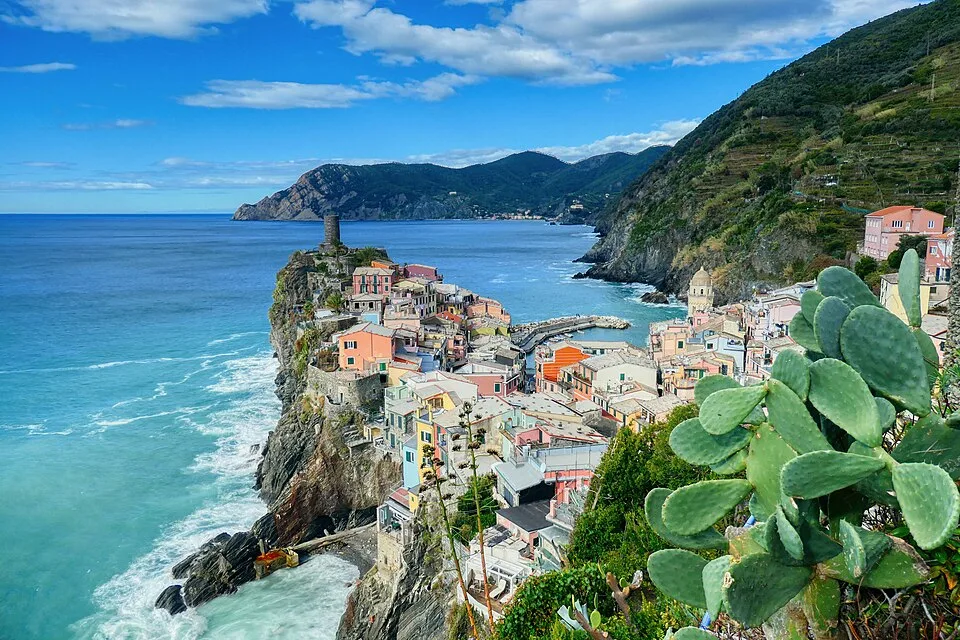
Cinque Terre in April — the month most people underestimate
April is when Cinque Terre works properly. The crowds that render Vernazza's harbor invisible under a canopy of selfie sticks in July haven't arrived. The hiking trails — many of which close in winter for maintenance and rockfall — are reopening. Temperatures run 14-19°C: warm enough to eat outside on a harbor terrace and walk the cliffside paths, cool enough to do it without serious physical discomfort. The hillside terraces are blooming. And the five villages — Monterosso, Vernazza, Corniglia, Manarola, Riomaggiore — are still functioning as places where people actually live, not just outdoor sets for tourism.
14-19°CAverage April temperature
60%Fewer visitors vs July
5Villages in Cinque Terre
€18.50Cinque Terre Card (trails + trains, 2 days)
382Steps from Corniglia station to the village
1997UNESCO World Heritage designation
Is April a good time to visit Cinque Terre?
April is one of the two best months to visit Cinque Terre — the other is October. The summer overcrowding that reaches genuinely problematic levels (there were crowd-control measures and visitor caps implemented in Vernazza and Riomaggiore in recent years) hasn't built up. The trail network is reopening after winter maintenance. Hotels cost 25-40% less than peak season. Easter weekend — if your visit falls over Easter, book accommodation 2-3 months ahead; even April Easter brings meaningful extra visitor numbers. Outside Easter, April Cinque Terre is the closest thing to the experience that the photos promise but that July and August can't actually deliver.
What is the weather like in Cinque Terre in April?
Daytime temperatures range from 14-19°C through the month, noticeably warmer in late April than early April. Mornings on the cliffs can feel cool (10-12°C) when the sea wind picks up. Rain is possible — April averages 6-8 rainy days on the Ligurian coast, often as short intense showers rather than full-day rain. The light in April is extraordinary: long golden afternoons and a low sun angle that makes the colored facades of Manarola and Vernazza look almost artificially saturated. Pack layers — light jacket for mornings and evenings, waterproof layer for sudden showers, proper hiking shoes or trail runners rather than sneakers for the cliffside paths, which can be slippery after rain.
📜 Why Cinque Terre villages cling to vertical rock
The five villages were not built for scenic effect. They were built for defense. The Ligurian coast from the early medieval period through the 18th century was relentlessly raided by Barbary corsairs — North African and Ottoman privateers who captured coastal populations for the slave markets of Algiers and Tunis. Estimates suggest hundreds of thousands of Ligurians, Sardinians, Sicilians, and Calabrians were enslaved between 1500-1800. Villages built on inaccessible cliffs were harder to attack; watchtowers gave warning time. Vernazza's square tower (the Torre Doria), Manarola's watchpost, Riomaggiore's castle — all were defensive structures first. The terraced vineyards that now make the landscape photographable were a secondary consequence: the steep cliffs had to be terraced with dry-stone walls to create any agricultural land at all. The Sciacchetrà wine from these terraces — a rare, amber-colored passito made from partially dried grapes — is one of Liguria's most distinctive products, produced in small quantities and almost impossible to find outside the region at fair prices.
Which Cinque Terre village is best to stay in April?
Vernazza and Monterosso are the two strongest bases for an April visit. Vernazza is the most photogenic — the natural harbor framed by the Doria tower and the church of Santa Margherita is the postcard image — and has a small but good selection of accommodation and restaurants. The harbor fills with fishing boats in the morning, which is worth waking up for. Monterosso is the only village with a proper sandy beach (the Fegina beach area, with a historic section separated by a rocky promontory), has more accommodation options, more restaurants, and more services — better for families and people who want more amenity. For maximum quiet and local feeling in April: Corniglia (smallest, on a clifftop, no harbor, 382 steps from the train station, but genuinely village-like) or Manarola.
Are the Cinque Terre trails open in April?
The trail situation in April is good but requires verification before you go. The main Sentiero Azzurro (Trail 2, the coastal path linking all five villages) has been partially disrupted by rockfall and erosion in recent years; specific sections open and close based on inspections after winter. The Via dell'Amore stretch (Riomaggiore to Manarola, 1km, the easiest flat section of the coastal trail) was restored and reopened in 2024 after years of closure. The upper red trails above the villages generally open in April and offer far better views with far fewer people than the main coastal path. Always check parconazionale5terre.it or the information office in any village station before hiking. The Cinque Terre Card (€18.50 for 2 days, includes trail access and train travel between villages) is required for all hiking trails.
How do you get to Cinque Terre from Florence or Rome in April?
From Florence: regional train from Santa Maria Novella to La Spezia Centrale (2h-2h30 depending on connection), then local Trenitalia train northward — all five villages are on this line. Journey time from La Spezia to Riomaggiore (first village) is about 10 minutes; to Monterosso (last village north) about 25 minutes. From Genoa: direct regional train to La Spezia (45 min). From Rome: Frecciarossa to La Spezia (3h30+ with connections at Genoa or Florence). Milan to La Spezia: 2h20 by regional or fast train. The Cinque Terre Card includes the short inter-village train hops, which is how most people move between the villages (particularly useful when some trails are closed).
What should you eat in Cinque Terre in April?
Trofie al pesto is the mandatory dish. Trofie is the regional Ligurian pasta shape — short, twisted, slightly irregular — and the basil pesto here is made from local Genovese basil (smaller, more aromatic leaves than the international varieties), pine nuts, Parmigiano Reggiano, Pecorino Sardo, garlic, and Ligurian extra-virgin olive oil, traditionally pounded in a marble mortar. The friction of mortar and pestle breaks down the basil cells differently from a blender, producing a creamier, less oxidized result. This is not the jarred green paste. Eat it with trofie pasta in any trattoria in any of the five villages. Also: focaccia (Ligurian focaccia is olive-oil-rich and thick), local anchovies (acciughe di Monterosso — the local anchovy fishery was a major industry and the salt-cured product is among Italy's best), and Sciacchetrà with almond cookies as an after-dinner indulgence if you can find a restaurant or enoteca that pours it by the glass.
Is Cinque Terre worth visiting for only one day in April?
One day is enough to see the most famous views and eat the trofie al pesto. It's not enough to understand why people become attached to these villages. The standard one-day approach: take the morning train to Monterosso, walk the coastal trail southward (Monterosso to Vernazza is the most dramatic section — 1.5h of serious uphill on a clear day), have lunch in Vernazza harbor, take the train to Manarola for the sunset from the via dell'Amore viewpoint, train back to La Spezia. Two nights in one village allows for an early morning when the tourists haven't arrived, an evening when the daytrippers have left, and a sense of what these places actually feel like as living communities rather than scenic backdrops.
⚠️ Trail closures in April: Check trail status at parconazionale5terre.it before hiking. April closures after late-winter rain happen unpredictably. If your planned section is closed, the train between villages runs frequently (every 20-30 minutes in April) and the inter-village train journeys are included in the Cinque Terre Card.
More Cinque Terre and Liguria guides
More Cinque Terre in April questions answered directly
How do you buy the Cinque Terre Card in April?
The Cinque Terre Card (Carta Cinque Terre) is sold at the train station information offices in La Spezia, Riomaggiore, Manarola, Vernazza, and Monterosso, as well as online at parconazionale5terre.it. In April, you can usually buy on arrival without queuing. The standard 2-day card costs €18.50 and includes unlimited trail access plus local trains between the five villages. A 1-day card exists at €11.50. There is also a "Cinque Terre Trekking" card version without the train component at lower cost if you only plan to hike and have already purchased a separate train pass. April trail conditions mean checking which sections are open at the information office when you buy the card — the staff will tell you directly what is and isn't accessible.
Cinque Terre in April vs June — what's the actual difference?
Crowds: significantly lower in April. A typical July Saturday in Vernazza has 6,000-8,000 visitors passing through a village with a permanent population of about 800. April Saturday: perhaps 1,500-2,000. The difference is experiential rather than numerical — in April, you can eat lunch at a harbor-side restaurant without waiting 45 minutes, you can stand at a viewpoint without 15 other people in your shot, and you can walk the trail without maintaining a queue pace set by the slowest person ahead of you. Prices: April accommodation runs 25-40% less than June. Weather: April can have rain and cool mornings; June is consistently warm (22-26°C). The tradeoff is clear: April gives you the places as places; June gives you guaranteed warmth but compromises the experience with density.
What is the Via dell'Amore and is it open in April 2026?
The Via dell'Amore (Path of Love) is the most famous section of the Cinque Terre coastal trail: a 1km flat cliffside path cut into the rock linking Riomaggiore and Manarola, accessible to anyone regardless of fitness level. It was closed from 2012 after a rockfall and extensively restored. It reopened in 2024. As of early 2026, it should be open in April — verify at parconazionale5terre.it or at the Riomaggiore information office when you arrive, as rockfall closures can recur after significant winter rain. The path itself takes 20-25 minutes to walk one way and has the classic Cinque Terre view: cliffs, terraced vineyards, boats in the water, the adjacent village visible in the distance.
How do you get from Cinque Terre to Florence in April?
The return journey from Cinque Terre to Florence: local train from any village to La Spezia Centrale, then regional train La Spezia to Florence Santa Maria Novella (2h direct or 2h30 with change). Total door-to-door: 2.5-3h from most Cinque Terre villages. No need to book the La Spezia–Florence regional train in advance in April (it's not a high-speed service with seat reservations); just show up and buy a ticket at La Spezia station or use the Trenitalia app. April Cinque Terre means you can realistically do a 2-night stay and return to Florence by early afternoon for the third day without losing significant time.
💡 The anchovy season in April: Monterosso's anchovies (acciughe di Monterosso) are harvested from spring through early summer. In April, the local anchovy season is beginning and the cantiniere (small winemakers) are also starting to open their doors. A combination of fresh anchovies marinaded in lemon and olive oil, a glass of Sciacchetrà poured by the producer directly from the barrel, and a view of the harbor from a second-floor restaurant — this is specifically an April experience that July's crowds make significantly harder to have.
Is there parking near Cinque Terre for April visitors arriving by car?
Cars cannot enter the five villages — the roads are too narrow and most sections are closed to non-resident vehicles. The main car park serving the Cinque Terre is at La Spezia (various car parks near the train station, €15-20/day) — take the local train from La Spezia into the villages. There are also smaller car parks at the villages' outskirts (Riomaggiore has a car park on the upper road, Campo di Manarola has limited parking) but these fill by 9am on weekends even in April. The practical approach: train or bus to La Spezia from your accommodation, park at La Spezia if driving. In April the car parks are less saturated than summer, but a Saturday by 10am sees them full.
What is the Cinque Terre National Park and how does it affect your visit?
The Parco Nazionale delle Cinque Terre was established in 1999 and covers the five villages plus the coastal and hillside territory between them. It manages the trail network, the marine protected area (no motorboats in certain zones, protecting the seabed), and environmental regulations for the entire area. The National Park controls trail access and charges the Cinque Terre Card fee for trail use. In recent years, the park has implemented crowd management measures in response to the dramatic overtourism of the 2015-2019 period — daily visitor caps in certain areas, restrictions on large tour groups, and reduced capacity on the most fragile trail sections. These measures make the April experience notably better than high summer: April visitor numbers are within the park's comfortable capacity range, while July-August often strains the limits. The park's website (parconazionale5terre.it) is the authoritative source for current trail status, visitor caps, and any new regulations for 2026.
Plan your Italian trip — free
Our AI builds a day-by-day itinerary with real transport, real opening times, real prices.
Build my itinerary →