Cinque Terre vs Portofino: The UNESCO Villages Against the Yacht Harbour
Portofino has 422 permanent residents and no parking within 500m of the village — the access road ends at a paid car park 3km away, and you walk or take a boat. The village has been explicitly designed (by topography, by planning restrictions, and by price) to remain small and exclusive. Cinque Terre has 7,000 permanent residents across five villages, a UNESCO designation that generates 2.5 million annual visitors, and a trail card system that charges €7.50 to walk between the villages. These are not comparable situations, but they are both specifically Ligurian.
Cinque Terre: The Five Villages and the Management Crisis
Cinque Terre (the five villages — Monterosso al Mare, Vernazza, Corniglia, Manarola, and Riomaggiore — on the Ligurian cliff coast of the La Spezia province, UNESCO World Heritage 1997) are the most internationally famous Italian coastal villages. The specific Cinque Terre situation: 2.5 million annual visitors to a permanently inhabited fishing village system of 7,000 residents and terrain that physically cannot accommodate them simultaneously (the cliff-face village structure, the terraced vineyard and olive grove landscape, the 12km of stone footpaths connecting the villages — all built for a population of shepherds, fishermen, and farmers, not for mass tourism). The 2011 flood (the October 25 flood that destroyed parts of Monterosso and Vernazza, killing 9 people, the result of the specific hydrological vulnerability of a system where the terracing maintenance had been progressively abandoned as the fishing economy declined) exposed the specific Cinque Terre crisis: the villages' survival as inhabited places depends on the landscape maintenance (the dry-stone terrace walls and drainage channels that prevent the catastrophic landslide events) that only a resident agricultural population can perform, and that population has been declining since the 1950s as the fishing and farming economy failed to compete with the tourist economy.
The Cinque Terre National Park response: the trail card (€7.50–10 per person per day for the coastal path access), the visitor number monitoring systems (the turnstiles at the trail access points, installed 2021), and the advocacy for visitor distribution (the Corniglia strategy — the least visited of the five villages, accessible only by the 377-step staircase from the Corniglia station, the most specifically Cinque Terre experience precisely because the steps filter the casual visitor). The specific Cinque Terre visitor advice: Corniglia in May on a Tuesday. The trail from Corniglia to Manarola (the Via Beccara — the most scenic and least crowded section of the Cinque Terre trail system, through the vineyard terracing with the sea visible below). This is the Cinque Terre that exists in the photographs.
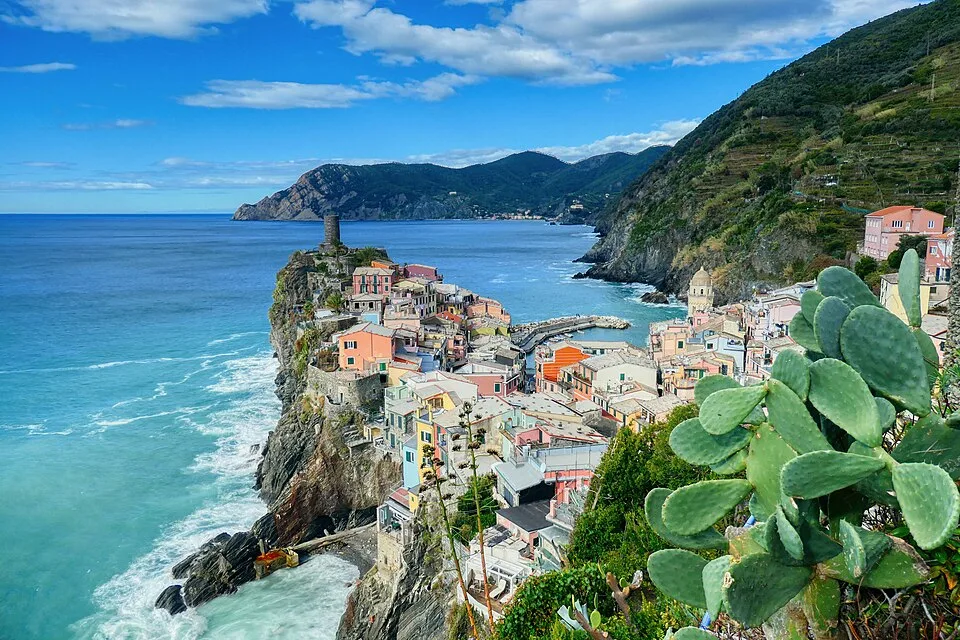
The Vernazza harbour and why it matters: Vernazza is consistently rated the most beautiful of the five Cinque Terre villages — the specific reason is the harbour. The Vernazza harbour (the small boat basin enclosed by the medieval tower and the Sant'Andrea church, the only natural harbour in the five villages) is the most compositionally perfect small harbour in Italy: the coloured facades of the harbour-front houses, the Sant'Andrea apses at the water's edge, the Doria tower on the headland, and the open sea beyond the harbour entrance frame a specific view that has been reproduced in Italian postal stamps, travel posters, and tourist photography since the 1950s. The 2011 flood that destroyed the Vernazza harbour (the mud flow from the Val di Vernazza above the village filled the harbour to roof height, destroying the ground-floor shops and restaurants) and the subsequent 18-month recovery and reconstruction is the most recent chapter in the specific Cinque Terre resilience narrative. The specific Vernazza experience on a Wednesday morning in October: the harbour at 8am with the fishing boats returning, the terracing in the autumn harvest stage (the Sciachetrà wine grape harvest is in October), and the tourist number approximately 15% of August. This is when Vernazza is itself.
Portofino: The Exclusion Design
Portofino (the village in the Tigullio Gulf, Genova province — population 422, the smallest municipality in Liguria by population) was already a luxury destination in 1954 when Rex Harrison and Liz Taylor filmed on the waterfront — the specific Portofino luxury character predates the mass tourism era and has been maintained through a combination of genuine geographic inaccessibility (the road from Santa Margherita Ligure to Portofino is single-lane, the last 3km managed by a traffic light system that stops cars while boats proceed; in summer, the road is often closed to private cars entirely), planning restrictions (no new buildings, no signage, no large commercial operations), and price (the Portofino waterfront bar coffee is €8–12, the hotel rooms start at €500, the moorings in the harbour are €500+ per night for a mid-size yacht). The result is a village that looks approximately as it did in 1954 — the specific pale yellow, orange, and terracotta-painted facades of the harbour-front, the fishing boats alongside the yachts, the piazzetta at the harbour head — preserved by the combination of inaccessibility and exclusivity. The Portofino walk: the most accessible Portofino experience without paying harbour prices is the walk from the Paraggi beach (the small sandy beach 1.5km before Portofino on the road from Santa Margherita — free beach sections alongside the beach clubs) to the village (25 minutes on foot on the coast road), then continuing to the San Fruttuoso monastery (the 13th-century Benedictine monastery accessible by boat from Portofino or Camogli, or by the 1.5-hour coastal footpath from Portofino — the most dramatically positioned monastery in Liguria, accessible only by sea or trail).
Is Cinque Terre or Portofino better to visit?
Cinque Terre vs Portofino depends entirely on what you want. Cinque Terre is better for: the coastal walking trail experience (the most famous Italian cliff walking circuit), the village-hopping by train (the most efficient Cinque Terre format — regional train between all 5 stations, €4 per journey), the specific Italian vernacular village architecture at scale, and the Vernazza harbour photograph. It requires crowd management strategy (early morning, shoulder season, trail card €7.50–10). Portofino is better for: the yacht harbour glamour, the most intact Ligurian fishing village atmosphere (paradoxically — the exclusivity has preserved the architecture), the San Fruttuoso monastery boat excursion (€15 from Portofino, the most dramatically approached Italian monastery), and the Paraggi beach (the only sandy beach on the Portofino promontory). Price: Portofino is significantly more expensive (€8–12 coffee vs €2–3 at Cinque Terre bar; hotel prices start higher). The most practical combination: Cinque Terre 2 days + Portofino half day from Santa Margherita Ligure base.
The Ligurian Coast Between the Two: What Most Visitors Miss
The Ligurian coast between Cinque Terre and Portofino has specific assets that neither endpoint has: the Levanto beach (the large sandy beach immediately north of the Cinque Terre — the most accessible Ligurian sandy beach, the surf school destination, the train station providing the easiest Cinque Terre base with space for families), the Moneglia beach (the small town with a sandy beach south of Sestri Levante — the least touristic Ligurian resort, the specific painted buildings of the old town, the absence of Cinque Terre trail card and crowd), and the Sestri Levante Baia del Silenzio (the Bay of Silence — the small harbour cove on the Sestri Levante peninsula, the most specifically Ligurian harbour beach, sand, coloured buildings, and the Marconi radio experiment monument — Guglielmo Marconi tested his wireless radio transmissions from the Sestri Levante headland in 1895). The Cinque Terre to Portofino coast by train (the regional line from La Spezia to Genova, stopping at all coastal towns) is the most specifically Ligurian rail journey — the tunnels that give way to brief cliff views, the stations carved into the limestone, the sea appearing and disappearing through the rock. Related: Liguria guide.
Plan Your Cinque Terre and Portofino Circuit
Cinque Terre trail card booking, Vernazza October harvest timing, San Fruttuoso monastery boat from Portofino, and the Levanto base for the Cinque Terre trail without the village accommodation premium.
Italy's Extraordinary Vernacular Music: The Regional Traditions Beyond Opera
Italian music is not only opera — the regional vernacular traditions (the folk, liturgical, and social music of specific Italian communities) represent the most musically diverse country in Europe:
The Neapolitan Song (Canzone Napoletana): The Neapolitan song tradition (O Sole Mio, Funiculì Funiculà, Santa Lucia — the most globally recognised Italian music after opera) was formalised at the Piedigrotta Festival (the Naples music festival, held annually on the 8th of September at the Piedigrotta sanctuary — the festival where the new season's songs were premiered, the most commercially consequential Italian music event of the late 19th and early 20th century). The songs were composed in Neapolitan dialect and produced the specific tenor vocal style (the Neapolitan tenor — the tradition that produced Caruso, Di Stefano, and their successors) that is the most internationally recognisable Italian vocal sound. The Piedigrotta tradition ended in the 1950s but the Canzone Napoletana remains the most commercially successful Italian regional music tradition in history. The Sicilian Canto alla Stisa: The Sicilian lament tradition (the specific mountain village vocal form in the Sicilian Madonie and Nebrodi, related to the Moorish muwashshah poetry tradition brought to Sicily during the Arab-Norman period) is the least studied and most extraordinary Italian vocal tradition — the specific extended interval use and the improvised verse form make it the closest surviving connection to the medieval Arab-Sicilian musical culture. The Sardinian Cantu a Tenore (UNESCO 2005): The Sardinian polyphonic male vocal tradition (the tenore group — 4 voices performing the specific harmonic convergence that the Barbagia mountain communities have maintained for at least 600 years, UNESCO 2005 Intangible Cultural Heritage) is the most technically extraordinary Italian vernacular music. Recordings: the Tenore di Orgosolo is the most internationally known group; performances at the Bar San Giorgio in Orgosolo (the Barbagia capital) on Sunday mornings are the most accessible live cantu a tenore experience.
What are Italy's traditional music forms?
Italy's most significant traditional music traditions: Canzone Napoletana (the Neapolitan song tradition — O Sole Mio, Funiculì Funiculà, the globally recognised Italian popular music of the 19th–20th century); Cantu a Tenore (the Sardinian Barbagia polyphonic vocal tradition, UNESCO 2005 — Orgosolo Sunday morning performances); the Sicilian puppet theatre music (the Opera dei Pupi musical tradition, UNESCO 2008); the Venetian gondolier singing tradition (the Barcarolle — the specific gondolier work song that Offenbach immortalised in Tales of Hoffmann, still performed at the Vogalonga rowing event in May); and the Roman Stornello (the improvised verse-singing tradition of the Roman Trastevere, the most specifically Roman vernacular musical form, documented from the 18th century and still performed at specific Roman osterie on Friday evenings). All are living traditions — the most accessible are the Sardinian tenore (Orgosolo) and the Neapolitan song tradition (performed at the San Carlo concert series and at the San Domenico Maggiore courtyard concerts in Naples). Related: Italy music guide.
Italy's Extraordinary Fresco Conservation: What the Restoration Process Actually Involves
Italian fresco restoration (the restauro — the conservation process that is simultaneously scientific, technical, and interpretive) is the most complex and most consequential art conservation discipline in the world. Italy has more significant frescoes requiring conservation than any other country. The specific restoration processes visible to visitors:
The Brancacci Chapel restoration (Florence, completed 1988): The Masaccio-Masolino-Filippino Lippi fresco cycle in the Brancacci Chapel (Santa Maria del Carmine, Piazza del Carmine, Florence — €8, advance booking required, timed entry, maximum 30 visitors per session) underwent the most celebrated Italian fresco restoration of the 20th century (1982–1988 — 6 years of cleaning, consolidation, and minimal reintegration by the Opificio delle Pietre Dure, the Florence conservation institute). The specific restoration challenge: the frescoes had been covered by 17th-century candle soot and grime to the point where the original Masaccio colours (the specific warm terracotta, the pale grey-blue sky that distinguishes Masaccio from every other early 15th-century Italian painter) were invisible. The 1988 cleaning revealed a chromatic range that changed the art historical understanding of the work — the Expulsion of Adam and Eve (the most emotionally concentrated image in the Brancacci cycle, the contorted Adam covering his face in shame while Eve screams into the sky) in its original colour was demonstrably more powerful than any reproduction made before the restoration. The Opificio delle Pietre Dure (Via Alfani 78, Florence — opd.it, the only museum in the world dedicated entirely to conservation science, free, Tuesday–Saturday 9am–2pm) allows visitors to observe ongoing restoration work through glass panels — the most specifically educational Italian art experience available. The Sistine Chapel ceiling: what the 1980–1994 restoration changed: The Michelangelo Sistine ceiling restoration (1980–1994, the most controversial Italian restoration project of the 20th century) removed the accumulation of 400 years of soot, wax, and previous restoration attempts to reveal colours (the brilliant orange, the sharp blue-green, the acid yellow) that most art historians had assumed were impossible for Michelangelo. The controversy: some scholars argued the restoration removed Michelangelo's own final glazing layer (the secco additions — the work done after the fresco dried). The debate continues, but the restored ceiling is now the accepted standard.
How are Italian frescoes restored?
Italian fresco restoration follows a sequence: documentation (photography and digital mapping of the current condition); consolidation (the injection of lime-based consolidants to re-attach detached intonaco — the plaster layer); cleaning (removal of surface deposits using distilled water, Japanese paper, and specific solvents appropriate to the deposit type); and minimal reintegration (the tratteggio technique — fine vertical hatching in reversible watercolour to fill lacunae without reproducing lost painting). The most important Italian conservation institution: the Opificio delle Pietre Dure (Via Alfani 78, Florence — opd.it, free museum Tuesday–Saturday 9am–2pm) developed the tratteggio technique and trains most Italian fresco conservators. The specific restoration standard in Italy: the "reversibility principle" (all conservation interventions must be reversible — removable without damage to the original — requiring that every material used in restoration be chemically distinct from the original and documented). Related: Florence art guide.
Plan the rest of your the Cinque Terre trip
The essentials, compared and booked with the official sellers. Same price for you; we may earn a commission.