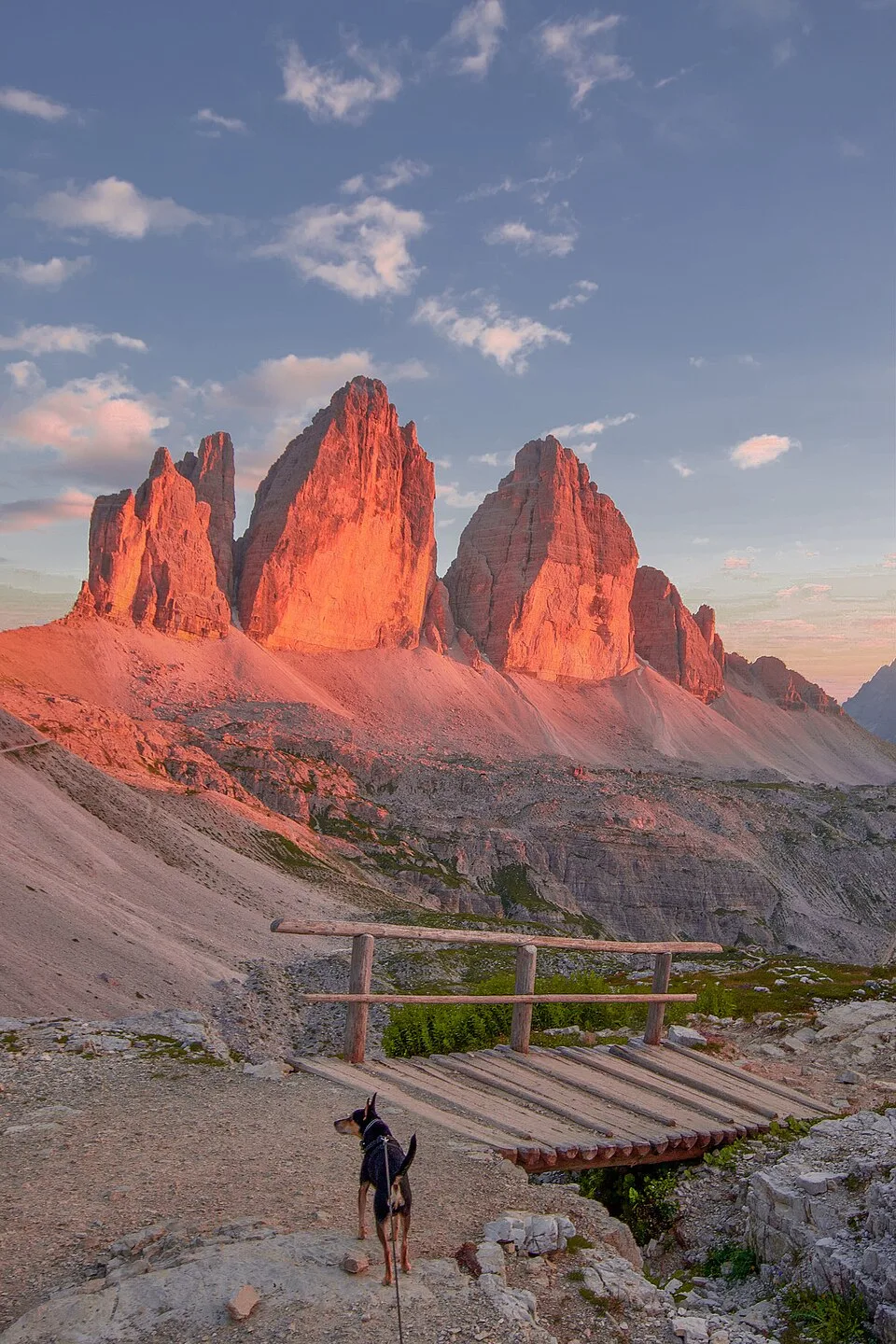
Best time to visit the Dolomites — the complete seasonal guide
The Dolomites are extraordinary in every season but completely different in each one. July gives the full trail network open, warm weather, and maximum crowd density. February gives world-class skiing and empty mountain huts. September gives most of July's advantages without the crowd overhead. Here is the honest month-by-month guide.
July-AugustFull hiking season — most crowded, best weather
SeptemberBest balance — trails open, crowds dropping, rifugi available
December-MarchSki season — best conditions February, Carnival period
May-JuneShoulder hiking — some high trails still snowbound
October-NovemberAutumn color, rifugi closing, fewer options
Mid-JuneFirst reliable opening of high-altitude trails
What is the best month to visit the Dolomites for hiking?
July (peak season): All trails open including the Tre Cime circuit, Alta Via 1, and all via ferratas. Rifugio bookings essential — the most popular rifugi (Rifugio Locatelli, Rifugio Lagazuoi, Rifugio Scotoni) book up in January for July. Weather is generally stable (afternoon thunderstorms are the main risk — start early, be below the ridgeline by 1pm). Crowds: the Tre Cime circuit in July has 2,000-3,000 walkers per day; the Alta Via 1 is significantly less crowded. September (recommended): The best single month for a first Dolomites hiking visit — trails fully open, summer crowds have dropped by 30-40% after Italian school return (usually September 15-20), rifugi have availability, the autumn light quality produces extraordinary photography conditions (lower sun angle, clearer air after the summer haze). The one risk: some high rifugi close in mid-September; check specific closures at altaviadolomiti.it. Late June (opening shoulder): The Tre Cime access road opens in mid-June; the Alta Via 1 sections above 2,500m may still have snow fields in early June. The advantage: no crowds, full rifugio capacity available, prices at shoulder season rates. Bring microspikes for potential snow patches. August: The highest trail use month — Italian and German school holidays peak in mid-August. The Tre Cime circuit can be unpleasantly crowded at the Rifugio Locatelli section between 10am and 2pm. Solution: start at 6:30am and finish the circuit before the day-tripper buses arrive.
📜 The rifugio culture — why the Dolomites have mountain huts at 2,500m and what they represent
The rete dei rifugi (mountain hut network) in the Dolomites comprises approximately 150 active rifugi at altitudes of 1,800-3,000m — huts providing food, accommodation, and emergency shelter for walkers and climbers. The network was established in the late 19th century by the Österreichischer Alpenverein (Austrian Alpine Club, founded 1862) and the Deutsche Alpenvereion (DAV, founded 1869) specifically to support the first generation of recreational alpinists exploring the Dolomites. The construction of rifugi followed the first ascents — Rifugio Auronzo (now the Tre Cime trailhead) was established in 1883, the year after the first circuit walk was mapped. The specific Italian tradition: after 1918 (when the Dolomites became Italian), the Club Alpino Italiano (CAI, founded in Turin in 1863 and the oldest alpine club in continental Europe) managed the transition of the German-Austrian network to Italian ownership. Most Dolomite rifugi today are managed by family operators who hold CAI concessions; the food served (canederli in broth, polenta with speck, apple strudel) reflects the Austro-Italian-Ladin cultural synthesis of the valleys below. Staying overnight at a rifugio gives access to the most extraordinary sunrise in Italian outdoor culture — the Enrosadira effect (the Ladin word for the specific pink-red glow that the Dolomite limestone produces at sunrise and sunset) is visible for approximately 20 minutes and is specifically more intense from altitude than from the valleys.
What are Italy's best under-visited cities that reward a multi-day visit?
Ten Italian cities that rarely appear on first-trip itineraries but deliver experiences comparable to the main triangle: (1) Lecce (Puglia — the Baroque capital of southern Italy, with a specific local sandstone (pietra leccese) that carves to extraordinary detail; the Basilica di Santa Croce facade is the most ornate Baroque building in Italy; the old city is compact and walkable, the nightlife around Piazza Santo Oronzo is excellent, and the accommodation is significantly cheaper than Florence or Rome); (2) Matera (Basilicata — one of the oldest continuously inhabited cities in the world, the cave-dwelling sassi have been occupied for 9,000 years; UNESCO World Heritage and European Capital of Culture 2019; approaching by car at dusk from the Murgia plateau opposite gives the most extraordinary Italian urban view after the Amalfi Coast); (3) Verona (Veneto — the Roman Arena (still used for opera, the largest surviving Roman amphitheater after the Colosseum), the Romeo and Juliet tradition, the superb Piazza delle Erbe market, 1h from Venice and 1.5h from Milan; consistently overlooked); (4) Lucca (Tuscany — the only Italian city with intact Renaissance walls (converted to a public promenade and bike path), the Torre Guinigi with the trees growing from the top, the extraordinary density of Romanesque churches in a compact pedestrian center, and almost no visitors compared to Pisa or Florence 30 minutes away); (5) Trieste (Friuli-Venezia Giulia — the Habsburg port city, the most Central European Italian city, the extraordinary coffee bar culture (the local espresso terminology is completely different from the rest of Italy), James Joyce lived and wrote here 1904-1915, and the Carso plateau above the city gives the most unusual Italian landscape in the north); (6) Orvieto (Umbria — the most spectacular Italian hilltop city after Matera, with the cathedral facade (begun 1290) producing the finest Gothic facade in Italy; the underground Etruscan and medieval cave network below the city; 1h15 by train from Rome and an obvious overnight from the capital); (7) Bari Vecchia (Puglia — the medieval old city of Bari, with the Basilica di San Nicola (the finest Norman church in Puglia), the fishermen's wives making orecchiette by hand in the streets outside their front doors (Via dell'Arco Basso and the surrounding lanes), and the most authentic street food in southern Italy at a fraction of the Naples prices); (8) Ravenna (Emilia-Romagna — eight UNESCO World Heritage monuments in a small city; the 5th-6th century mosaics at the Mausoleum of Galla Placidia, San Vitale, and Sant'Apollinare Nuovo are the finest Byzantine art in the Western world, rivaling the Hagia Sophia; 1h30 from Bologna by train); (9) Alberobello (Puglia — the trulli district, a UNESCO World Heritage town of conical stone-roofed houses unique in the world, entirely concentrated in the Rione Monti area; worth a half-day from Bari or a night in a trullo house); (10) Ferrara (Emilia-Romagna — the Renaissance Este court city, a UNESCO World Heritage site, with the Castello Estense moated castle, the most complete Renaissance urban plan in Italy, and the best bicycle culture of any Italian city).
What are the most important things first-time Italy visitors wish they had known before arriving?
Eight things experienced Italy visitors consistently say they wish they had known on their first trip: (1) The advance booking requirement is real and not optional. The Vatican Museums, the Colosseum, the Borghese Gallery, the Uffizi in summer — these are not "nice to pre-book" suggestions. Arriving without a booking in July produces either a 2-3 hour queue or no entry. The booking fees (€4-5 per ticket) are the best money spent in Italy. (2) The best food is never near the tourist monuments. The 300-metre rule applies in every Italian city: walk 300 metres from any major monument and the restaurant quality improves by approximately 30-40% and the price drops by 20-25%. (3) Italian cities are best experienced at city pace, not monument pace. Two hours at the Uffizi produces better memories than three museums in a day — the specific Florentine quality comes from the Botticelli room, not from having been to the Bargello and the Accademia on the same day. (4) September and October are better than July and August for almost everything. Slightly lower temperatures, significantly lower crowd density (20-40% fewer visitors at major sites after Italian school return), lower accommodation prices, and the specific quality of Italian autumn light. The only trade-off: the Cinque Terre trails and some mountain huts begin closing in mid-October. (5) The Italian lunch hour is still real. Many churches, smaller museums, and shops close 1-3pm or 12:30-3:30pm. Planning around these hours (museums before noon, long lunch during the siesta, afternoon activity from 4pm) is not time wasted. (6) The train is always better than the car in cities. Parking in Rome costs €20-30/day in a garage (street parking is essentially unavailable); in Florence the ZTL restricted zone covers the entire historic center with €100 fines for unauthorized entry; in Venice there are no cars. The Frecciarossa is faster than driving between major cities and drops you in the city center. (7) Italian coffee culture is specific and worth learning. The 30 seconds standing at an Italian bar counter, ordering espresso by making eye contact, paying €1.50, and drinking it immediately is one of the most compressed expressions of Italian daily culture. Ordering a "large coffee" or a Starbucks-style drink at an Italian bar misses the point and the experience. (8) Free doesn't mean lesser in Italy. The Pantheon interior (€5, originally free), the Trevi Fountain, the Spanish Steps, the 900 churches with extraordinary art — the cost of experiencing the finest things in Italy is very low if you know which things are free. The €20 Vatican Museums and the €0 church with a Caravaggio down the street are 200 metres apart.
What are the most specific Italy practical tips that only come from having been there?
Ten granular Italy practical tips from experience: (1) The Vatican dress code turns people away without sympathy. The guards at St. Peter's Basilica will turn away anyone with bare knees or bare shoulders, regardless of how much they paid for their flight or how far they traveled. The solution is always to carry a pashmina or light jacket that can be wrapped around the waist for knees and draped over the shoulders. €5 shawls are sold outside; buying one in advance is better. (2) The Colosseum is always worth seeing from outside, even without a ticket. The Forum is the real prize — the valley between the Palatine and Capitoline Hills containing 1,000 years of Roman civic architecture — and it is included in the Colosseum ticket. (3) Book train tickets on the specific departure you want, not a flexible ticket. The Frecciarossa "Base" fare is €19-29; the "Flex" fare is €49-69. The difference is the ability to change. For planned trips, Base is always the right choice. (4) Pharmacists in Italy are more medically capable than in most countries. For minor ailments, the farmacia (look for the green cross) can advise and dispense treatments without a doctor visit. This saves the cost and delay of finding an English-speaking medical service. (5) The "no photos" rule in the Sistine Chapel is enforced by guards with whistles. The flash photography ban is absolute (flash damages the Michelangelo ceiling's colors). Phone photography without flash is technically banned but practically monitored inconsistently at crowd times. The guards will loudly stop anyone who tries to take photos. (6) Via del Corso in Rome and Via Tornabuoni in Florence are the main shopping streets and are designed for window shopping, not bargain purchases. The independent shops on the parallel streets sell the same brands at lower tourist markup. (7) The Italian "€1 entry fee" is often not optional. Some churches charge €1-3 to enter even though the church appears free; the fee is collected at a small desk inside. This is legitimate and goes to church maintenance. (8) The orange grove and citrus garden rule. Any restaurant near a lemon grove on the Amalfi Coast or an orange grove in Sicily that prominently features the citrus in its decor will charge a significant premium for that view. The food will be adequate. Walk away from the grove view by 50 metres and the price drops 25%. (9) Vaporetto day passes in Venice are genuinely worth buying. The €25 24-hour pass covers unlimited journeys on the main vaporetto lines; at €9.50 per single journey, 3 journeys makes it worthwhile. Book online at actv.it to avoid the queue at Santa Lucia. (10) The single most reliable restaurant quality indicator in Italy is the presence of local workers at lunch. Any trattoria, osteria, or tavola calda where Italian-speaking workers are eating their midday meal at 12:30-1:30pm on a weekday will serve real, affordable food. Follow the workers.
💡 The thing about Italian cities that guidebooks never quite capture: They are built for living, not for visiting — and the best Italian travel experiences come from overlapping with the living rather than exclusively with the visiting. The aperitivo bar where the same people have been drinking for 30 years, the church where the neighborhood mass is still attended by the neighborhood elderly, the market stall where the vendor recognizes the regular customers and serves them slightly better than the strangers — these are not tourist experiences and they don't require any special effort to access. They require only arriving slightly earlier, staying slightly later, and paying attention to what the city is doing rather than what it is showing.
Plan your Italian trip — free
Our AI builds a day-by-day itinerary with real transport, real opening times, real prices.
Build my itinerary →